
Free UK standard shipping on orders £50 and over.

What to Look for in a Beef Liver Supplement (And What Most Brands Won't Tell You)
August 02, 2026 13 min read
Not all beef liver supplements are created equal, and if you have been shopping around, you have probably noticed the market is flooded with options that all claim to be the gold standard. The problem is that most brands are counting on you not knowing what to look for.
Beef liver supplements can be a powerful addition to your nutrition routine, delivering a concentrated source of vitamin A, B12, iron, and CoQ10 that most modern diets simply cannot match. But the difference between a supplement that genuinely delivers these benefits and one that is little more than an expensive capsule of filler comes down to a handful of critical factors most companies quietly gloss over.
In this post, we are breaking down exactly what separates a high-quality beef liver supplement from a subpar one. You will learn which sourcing and processing details actually matter, which label claims are meaningful versus misleading, and what red flags to watch for before you spend your money. Whether you are new to organ supplements or looking to upgrade your current stack, this guide will help you make a smarter, more informed choice.
Grass-Fed vs. Grass-Finished: Why the Label Is Not Enough
The "grass-fed" label sounds reassuring, but it conceals one of the most significant loopholes in the entire supplement industry. In many markets, the term is legally permissible even when cattle have been grain-finished during the critical final months before slaughter. An animal can spend the majority of its life on pasture and still carry a grass-fed label after transitioning to a grain-based feedlot diet. For beef liver supplement buyers, this is not a minor technicality; it directly affects the nutritional value of what ends up in the capsule.
Why the Finishing Period Is What Actually Matters
The finishing stage, those final weeks and months before slaughter, is precisely when fat-soluble vitamins and fatty acid profiles in the liver are most heavily influenced by diet. Research published in Nutrition Journal confirmed that grass-based diets produce beef with significantly higher concentrations of vitamin E, conjugated linoleic acid (CLA), and omega-3 fatty acids compared to grain-fed alternatives. Grass-finished beef liver delivers meaningfully elevated levels of vitamins A, D, E, and K2, alongside a more favourable omega-3 to omega-6 ratio. Grain finishing shifts that ratio toward omega-6, a pro-inflammatory profile that undermines the core reason most people reach for a liver supplement in the first place.
This nutritional distinction is not marginal. It is structural, rooted in what the animal ate during the period that most directly shapes the liver's micronutrient density.
The Nutritional Argument Collapses Without It
Fat-soluble vitamins are the headline benefit of beef liver supplementation. Vitamin A, D, E, and K2 are the primary nutrients driving consumer interest in this category. As reviewed in depth for 2026 consumers, the nutritional gap between grass-fed and conventionally raised liver is an increasingly prominent area of awareness among informed buyers. If the sourcing does not confirm grass-finishing, the concentrations of precisely those vitamins may be considerably lower than the label implies.
What to Look For Before Buying
Go beyond the front-label claim. Look for products that explicitly state "grass-finished" or "100% pasture-raised," accompanied by a named country or farm region. Vague phrases like "quality-sourced" or "premium farms" carry no verifiable meaning. A dedicated sourcing page is a strong trust signal; brands using genuinely grass-finished cattle have both the commercial incentive and the supply chain knowledge to explain their practices clearly.
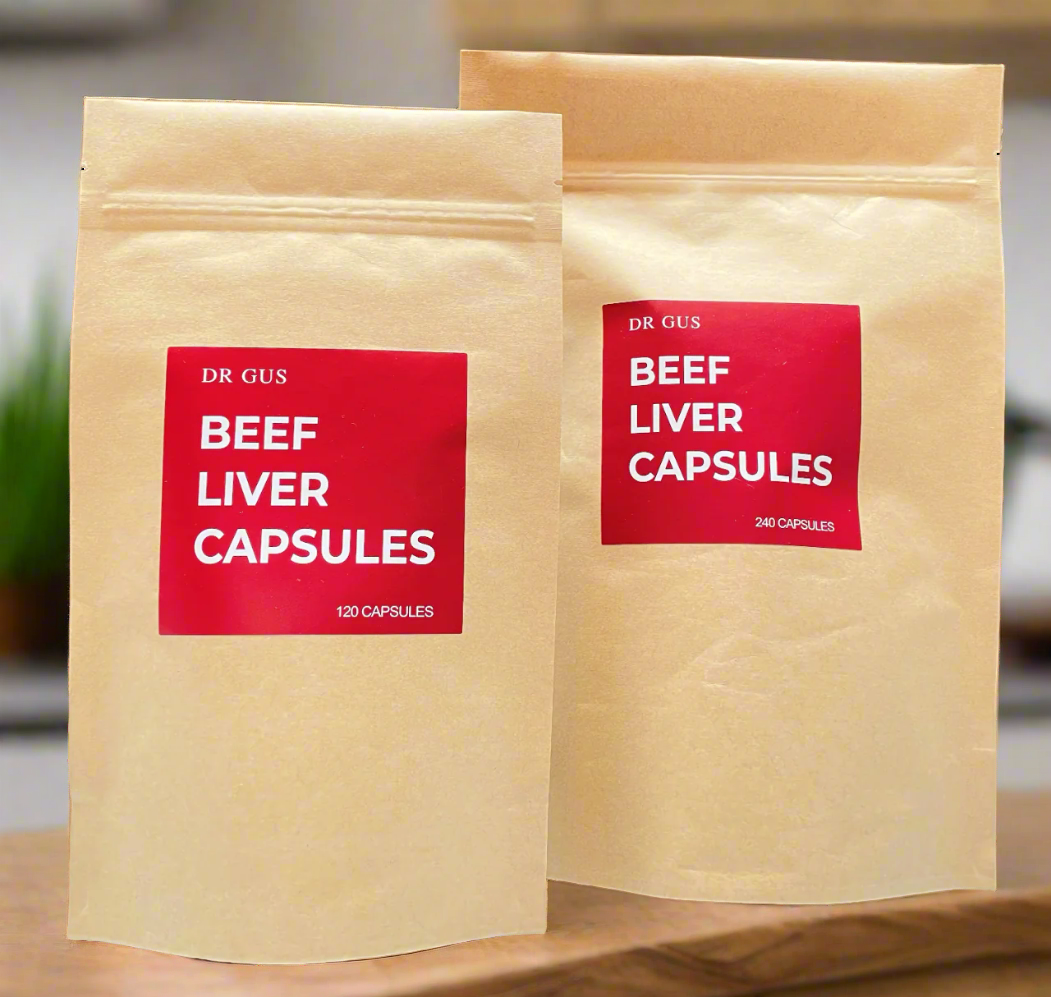
DR GUS Beef Liver Capsules are sourced from grass-finished cattle, with transparent disclosure of finishing practice rather than relying solely on the broader "grass-fed" term. That distinction is not marketing language; it is the difference between a supplement that delivers on its nutritional premise and one that does not.
Where the Liver Actually Comes From
Country of origin is a substantive quality variable, not a marketing footnote. The length of the grazing season, the mineral composition of the pasture, and the land management standards of the region all shape what ends up concentrated inside the liver itself. Cattle with year-round access to diverse, nutrient-rich pasture accumulate higher levels of fat-soluble vitamins, heme iron, and CoQ10 in their organ tissue compared to animals on shorter or interrupted grazing cycles. When you buy a beef liver supplement, you are not just buying a capsule; you are buying the cumulative nutritional output of everything that animal ate.
The UK, New Zealand and Australia are consistently cited as benchmark sourcing regions across the global supplement market, precisely because all countries benefit from nearly year-round pasture availability and strict agricultural standards. UK buyers should note, however, that a premium origin listed on a product page carries little weight unless the brand can confirm that origin applies to the current production batch, not just the original supplier relationship.
Multi-supplier rotation is a structural problem at the manufacturing level. As private label beef liver capsule manufacturers make clear, sourcing provenance in the organ meat supply chain requires active verification, and brands purchasing through intermediary producers may rotate origins without updating consumer-facing labels. A static sourcing page is not a guarantee.
DR GUS addresses this directly with a single-origin sourcing commitment, giving UK
customers a traceable, honest answer about what is inside each capsule rather than a broad claim anchored to wherever supply was cheapest at the time of the last production run.
If a brand's sourcing page is vague, ask the question directly via email or customer service. A supplier confident in its supply chain will answer without hesitation. An evasive or non-specific response is itself meaningful information about how seriously that brand treats quality control.
How It Is Processed: Freeze-Dried vs. Desiccated
Once sourcing and origin have been verified, processing method becomes the next critical variable separating a high-quality beef liver supplement from a mediocre one. How the liver is dried determines how much of its nutritional value actually survives to the point of consumption.
Freeze-drying (lyophilisation) removes moisture at low temperatures under vacuum conditions, which means the raw tissue is never exposed to the kind of heat that degrades sensitive compounds. Nutrients including vitamin B12, folate, and the fat-soluble vitamins A, D, E, and K2 are preserved in forms close to their original biological state. This matters because these are precisely the nutrients you are purchasing a beef liver supplement to obtain. Compromising them during production undermines the entire rationale for choosing a whole-food supplement over a synthetic alternative.
Conventional heat-drying, often labelled as desiccation, takes the opposite approach. It is faster and cheaper to produce, but it exposes liver tissue to elevated temperatures that can denature enzymes and degrade nutrient content. Vitamin A and the B vitamin complex are particularly vulnerable to heat degradation, making desiccated products a less reliable source of the micronutrients they claim to deliver. Understanding what distinguishes these two methods before purchasing is a practical step most buyers skip entirely.
Label transparency compounds the problem. Terms like "desiccated liver powder" or simply "dried liver" are commonly used across the category and do not indicate freeze-drying. Look for the phrase "freeze-dried" stated explicitly on the label; anything less specific should be treated with caution. As one detailed breakdown of the two methods confirms, preserving nutrient integrity through freeze-drying is a deliberate and active choice, not an industry default.
Capsule count is also not a reliable proxy for quality. A freeze-dried capsule with intact nutrient density is not equivalent to a heat-dried capsule of comparable weight. Volume tells you nothing about what survived processing. DR GUS uses a freeze-drying process specifically to ensure the nutritional integrity of the raw liver is maintained from source to capsule, so that what is listed on the label reflects what is actually being delivered.
What Is Actually in It: Reading the Nutrient Density Signals
Once sourcing, origin, and processing have been established, the next question is whether the nutrient payload inside those capsules is actually meaningful. This is where label literacy becomes essential.
A 3-oz serving of fresh beef liver delivers 4mg of iron, 17g of protein, and over 4,200 mcg RAE of vitamin A, according to Cleveland Clinic's nutritional analysis of beef liver. That single serving meets an adult's complete daily vitamin A requirement. The iron figure represents roughly half the recommended daily allowance for men, delivered in heme form, which absorbs two to three times more efficiently than the non-heme iron found in plant sources and most synthetic supplements. This is not a marginal advantage; it is a fundamental difference in how the body processes and retains the nutrient.
Beyond iron and vitamin A, beef liver is one of the most concentrated whole-food sources of B12, copper, riboflavin, folate, and choline available. Synthetic multivitamins attempt to replicate this profile, but they deliver isolated compounds stripped of the biological context that makes them usable. The copper in liver, for instance, works in direct synergy with its iron content, a co-factor relationship that does not exist in a standard iron tablet. Research on beef liver supplement bioavailability consistently points to this food-matrix advantage as the core reason whole-food organ supplements outperform their synthetic counterparts in absorption efficiency.
Organ meats occupy the top tier of the whole-food nutrient hierarchy because micronutrients arrive inside a biological matrix the body recognises, surrounded by enzymes and co-factors that support their uptake. This is the structural argument for beef liver supplements over conventional multivitamins, and it holds regardless of whether you are consuming the food directly or in encapsulated freeze-dried form.
When evaluating capsule products, always check the milligrams of liver per serving, not just the capsule count. A product offering six capsules per serving may still deliver a fraction of the nutrient equivalent found in a meaningful portion of fresh liver. Understanding what to look for in a beef liver supplement requires asking whether the brand discloses a nutrient equivalence benchmark relative to a fresh serving.
The ingredient list is the final signal. A legitimate, high-integrity product reads: beef liver (freeze-dried), capsule shell. Nothing else. Fillers, binders, magnesium stearate, maltodextrin, or any other excipient dilute the liver content per capsule and introduce unnecessary compounds into what should be a single-ingredient whole-food product. If the label cannot pass that simple test, the nutrient density conversation becomes irrelevant.
How Much to Take — and What That Actually Means in Practice
Most beef liver capsule products recommend 2 to 6 capsules per day. At 500 mg per capsule, that delivers 1.5g to 3g of freeze-dried liver, which is a fraction of the 85g (3-oz) fresh serving used in nutritional studies. A single 500 mg capsule represents roughly one-sixth of a full serving, meaning even six capsules only approximate the nutrient load of one meal-sized portion of whole liver. Understanding this ratio is not a reason to dismiss capsules; it is the foundation for using them correctly.
Consistency matters more than individual dose size. The nutrients in beef liver capsules accumulate over time. Taking three capsules daily for 30 to 90 days builds a sustained, meaningful contribution to your micronutrient intake, particularly for B12, heme iron, copper, and preformed vitamin A. This cumulative effect, layered alongside a varied whole-food diet, is where capsules earn their value. According to evidence-based dosage guidance published in 2026, different health goals genuinely require different doses, and adherence over weeks consistently outperforms irregular higher-dose use.
Capsules are not a replacement for eating whole liver. They are a practical tool for people who cannot or will not eat liver regularly, removing the barrier of preparation, sourcing, and tolerating a strong flavour. That distinction matters when setting expectations.
For athletes and active individuals, the iron and B12 content directly supports haemoglobin synthesis, oxygen transport, and recovery. Pairing beef liver capsules with a protein-sufficient diet maximises these contributions to energy metabolism, particularly under training load.
One practical habit worth building: take your capsules with a meal that contains some dietary fat. The fat-soluble vitamins delivered by beef liver, specifically vitamins A, D, E, and K2, require fat for absorption. A meal with eggs, avocado, olive oil, or any meat-based dish provides sufficient fat to meaningfully improve how well these nutrients are utilised. For detailed context on safe dosing and what standard capsule amounts actually deliver, this dosage guide reviewed by a medical doctor is a useful reference before adjusting intake.
Is It Safe? What You Need to Know About Vitamin A
The primary safety consideration with beef liver supplements comes down to one specific nutrient: preformed vitamin A, also known as retinol. Unlike beta-carotene from plant sources, which the body converts to active vitamin A only as needed and at a self-regulated rate, retinol from animal liver is absorbed directly and stored in body tissue. There is no built-in shutoff mechanism. This means chronic overconsumption is a genuine risk, even if acute toxicity from normal supplement use is not. Understanding the distinction between plant-derived and animal-derived vitamin A is foundational to using beef liver capsules responsibly.
The dose context matters significantly here. A single 3-oz serving of fresh beef liver delivers over 4,200 mcg RAE of vitamin A, which already exceeds the adult daily requirement in one sitting. At typical capsule doses of 1.5g to 3g of dried liver per day, a standard serving of beef liver supplement represents a fraction of that load, keeping intake well within safe ranges for most healthy adults. The NHS guidance on vitamin A sets the adult daily requirement at 700 mcg for men and 600 mcg for women, and notes that long-term daily intakes above 1,500 mcg are associated with reduced bone density and increased fracture risk, particularly in older women. The US Tolerable Upper Intake Level sits at 3,000 mcg RAE per day. Problems arise from chronically and significantly exceeding these thresholds, not from sensible, consistent capsule use.
The population that genuinely needs to exercise caution is pregnant women and those planning pregnancy. Research published in Cureus confirms that excessive preformed vitamin A intake during pregnancy is associated with central nervous system deformities and teratogenic risk. The NHS advises pregnant women to avoid liver and liver products for precisely this reason. High-dose beef liver supplements fall under the same guidance.
A commonly overlooked risk is supplement stacking. If you are already taking a standard multivitamin or a cod liver oil product alongside beef liver capsules, your combined daily vitamin A intake can exceed safe levels without you realising it. The NHS explicitly flags this scenario, noting that many multivitamins and fish liver oils contribute meaningful retinol loads that consumers routinely underestimate. Audit your full supplement stack before adding beef liver capsules, and prioritise products from brands that provide clear retinol content per serving.
Who Benefits Most from Beef Liver Supplements
Beef liver supplements are not a one-size-fits-all solution, but they are exceptionally well-suited to several distinct groups of people. Understanding which category applies to you makes a meaningful difference in how you approach dosage, consistency, and realistic expectations.
1. People replacing synthetic multivitamins
Beef liver delivers iron, B12, folate, copper, and vitamins A and D in a whole-food matrix where each nutrient exists alongside the co-factors required for its absorption. Synthetic isolates lack this context entirely. A useful illustration is the copper-iron relationship: without adequate copper, iron cannot be properly metabolised to produce red blood cells, a balance that occurs naturally in liver but is typically absent in manufactured supplements. The folate in liver is also naturally occurring, not the synthetic folic acid found in most multivitamins, which matters particularly for individuals with MTHFR gene variants affecting folate conversion. For anyone looking to consolidate their micronutrient intake through a single whole-food source, the nutritional science behind beef liver supplements presents a compelling evidence base.
2. Iron-deficient individuals and those with low ferritin
Haem iron from animal liver is absorbed at significantly higher rates than non-haem iron from plant foods or synthetic iron supplements. Importantly, a 2024 study documented that haem iron is also associated with fewer gastrointestinal side effects compared to ferrous sulfate and fumarate. For menstruating women, who face disproportionately higher iron requirements, beef liver represents one of the most practical and tolerable dietary tools available.
3. Athletes and those with high training loads
Bodybuilders and strength athletes have used liver supplements since the 1930s for sustained energy and recovery. The B12, iron, and CoQ10 content support mitochondrial function and reduce fatigue during heavy training blocks. The full B-complex present in liver also plays a direct role in converting food into usable cellular energy, making it functionally relevant beyond basic protein intake. Guidance on correct daily dosing is worth reviewing before starting, particularly for those already using other B-complex or iron products.
4. People following nose-to-tail, carnivore, or ancestral eating patterns
Beef liver capsules are a philosophically consistent extension of any dietary framework that prioritises whole-animal nutrient density. Traditional cultures relied on organ meats as some of the most prized foods available. Capsule form makes that nutrient profile accessible without requiring fresh organ preparation, which is a practical consideration for anyone maintaining this approach in a modern lifestyle.
5. Those who dislike the taste or texture of fresh liver
This is the single largest barrier to regular liver consumption for most people. Capsules eliminate it entirely. Consistent intake, not occasional consumption, is what produces meaningful nutritional benefit over time, and capsule form makes that consistency achievable for a significantly wider group of people.
A Note for UK Buyers: What to Know Before You Purchase
If you are buying beef liver supplements in the UK, understanding the regulatory environment is not an optional extra. It is foundational to making a well-informed purchase decision.
Food supplements sold in the UK are regulated as food products under retained EU law, specifically the Food Supplements (England) Regulations 2003 and its devolved equivalents. The Food Standards Agency oversees enforcement in England, Wales, and Northern Ireland. Critically, unlike pharmaceuticals, supplements are not subject to pre-market approval before they reach shelves. A product can legally enter the UK market without any independent body having verified its contents, potency, or label accuracy in advance.
This has a direct practical consequence. The accuracy of every claim on a supplement label, whether that is sourcing provenance, grass-finishing status, or nutrient density, is the manufacturer's responsibility, not a regulator-guaranteed fact. It is precisely why third-party testing documentation and supply chain transparency carry more weight than the marketing copy on the front of a pack.
Post-Brexit, the UK and EU now operate as distinct regulatory frameworks, with active divergence ongoing through 2025 to 2027. A product bearing EU compliance credentials is not automatically compliant with current UK rules. Imported products sold through online marketplaces add further complexity; traceability to the original production batch is often difficult to establish. A reputable UK brand should be able to confirm its current regulatory standing clearly and specifically.
DR GUS Nutrition is a UK-based brand producing grass-finished beef liver capsules formulated with clean, traceable ingredients and built specifically for the UK market. For buyers who want quality signals that go beyond label claims, starting with a domestic brand that can answer sourcing questions directly is the more defensible approach.
The Bottom Line: What a Good Beef Liver Supplement Actually Looks Like
The quality criteria covered throughout this guide are not arbitrary. A beef liver supplement that is grass-finished (not merely grass-fed), single-origin, freeze-dried, and free of fillers clears a bar that most products currently on the market simply do not meet. Apply those four filters and the field narrows considerably, which is precisely the point.
Consistency matters more than precise dosage. Taking three to six capsules daily with food, keeping track of vitamin A from other sources, and treating beef liver supplements as part of a broader nutrient-dense diet will deliver far better results than sporadic high doses. These are a complement to good nutrition, not a shortcut around it.
Pregnant women should consult a healthcare professional before use given the preformed vitamin A content. Everyone else benefits from understanding beef liver supplement dosage and staying comfortably within the upper tolerable intake level for retinol.
DR GUS Beef Liver Capsules satisfy every criterion this guide has outlined. Grass-finished, fully traceable, freeze-dried, and built on a simple two-ingredient formula, they represent exactly what a serious whole-food supplement should look like.
If synthetic multivitamins have been your baseline and you want to shift toward whole-food micronutrition, beef liver is one of the most effective and well-validated first steps available.
Conclusion
Finding a beef liver supplement that actually delivers requires cutting through the noise. Remember the essentials: sourcing matters, so look for grass-fed and pasture-raised on the label. Processing methods make or break nutrient preservation, so freeze-dried is your best option. Transparent labeling separates honest brands from those hiding behind vague claims. And third-party testing confirms you are getting what you paid for.
Do not let clever marketing convince you that all liver supplements are created equal. They are not.
Take what you have learned here and use it as your shopping checklist. Read the labels carefully, ask hard questions, and hold brands accountable to real standards. Your body deserves nutrition that actually works. The right supplement is out there; now you know exactly how to find it.
Leave a comment
Comments will be approved before showing up.